Overview
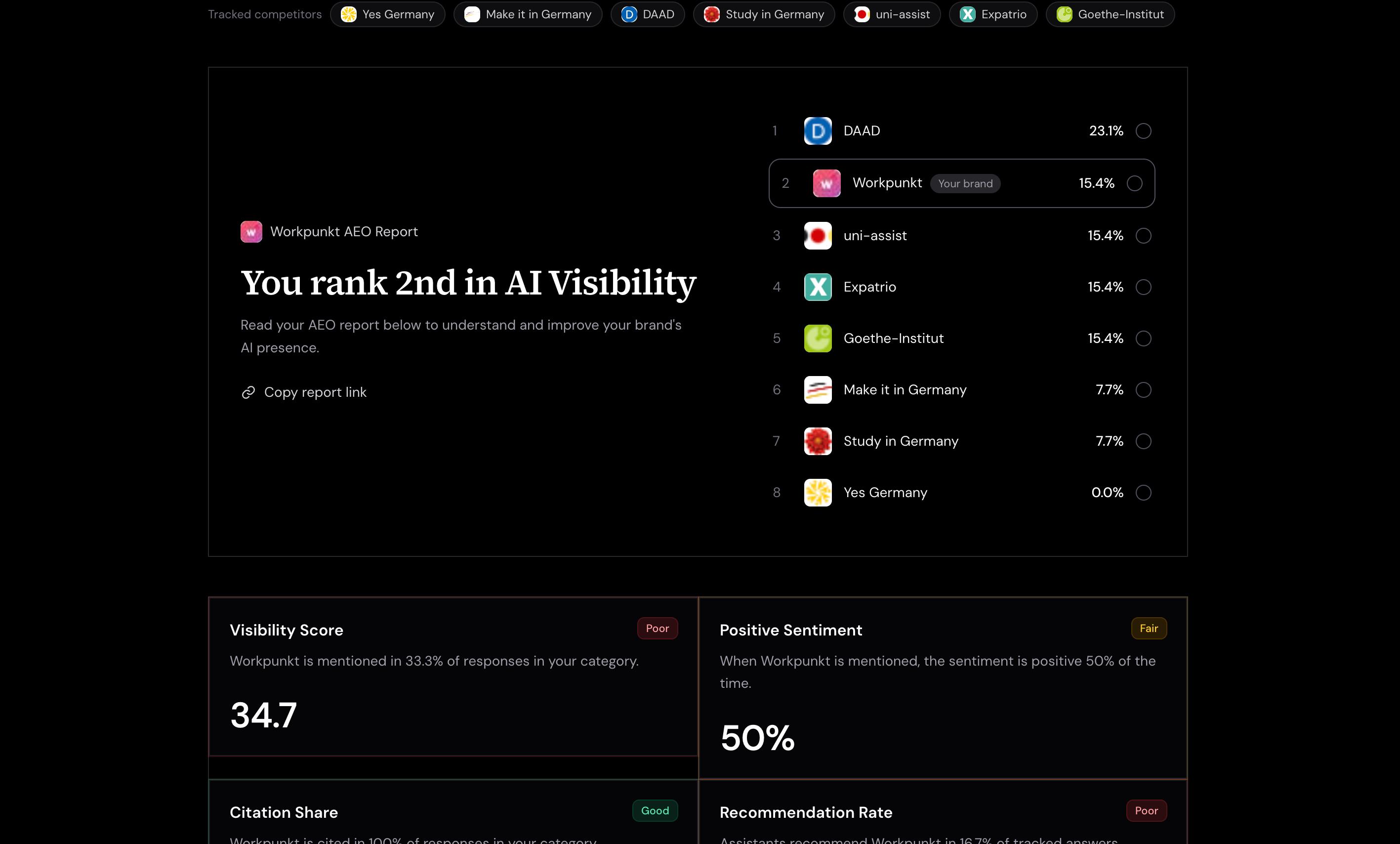
Cyted is an AI Visibility platform designed to answer a new category of analytics questions: How does a brand appear when potential customers ask AI systems for recommendations?
Instead of relying exclusively on traditional search rankings, the platform evaluates brand visibility, positioning, sentiment, and competitive presence across multiple Large Language Models.
I worked across the product architecture, AI integration layer, backend workflows, data processing, and frontend analytics experience.
System Architecture
The platform is built around a pipeline that transforms a user's buyer-intent configuration into structured AI visibility data.
At a high level:
Prompt Configuration → Query Orchestration → LLM Providers → Response Processing → Structured Analysis → Analytics Dashboard
The architecture was designed around provider abstraction so that individual LLM integrations do not become tightly coupled to the rest of the application.
Multi-LLM Orchestration
One of the core engineering challenges was querying multiple LLM providers while keeping the application responsive and resilient to provider-specific behavior.
The system supports providers including:
- OpenAI
- Anthropic Claude
- Google Gemini
- xAI Grok
- Mistral
Rather than implementing provider-specific logic throughout the application, LLM interactions are isolated behind a common abstraction layer.
This makes it easier to:
- Add new providers
- Handle provider-specific request formats
- Normalize responses
- Implement retries
- Handle failures independently
- Compare responses consistently
Asynchronous Processing
LLM requests can have significantly different response times and API constraints.
The backend therefore treats LLM execution as an asynchronous workload rather than blocking a single request until every provider responds.
The workflow focuses on:
- Concurrent execution
- Provider-level failure handling
- Rate-limit awareness
- Response normalization
- Structured result storage
- Incremental processing
This allows the system to scale the number of prompts and providers without turning a single HTTP request into a long-running operation.
Data Extraction & Analysis
Raw LLM responses are not directly useful for analytics.
The processing layer extracts structured information such as:
- Brand mentions
- Competitor mentions
- Relative positioning
- Sentiment
- Recommendation context
- Presence within AI-generated responses
This normalized data can then be used by the analytics layer instead of repeatedly parsing raw model output.
Frontend Architecture
The frontend is built using Next.js and React with a focus on making complex AI-generated data understandable.
The dashboard translates large amounts of model output into:
- Visibility metrics
- Brand comparisons
- Prompt-level results
- Provider-level performance
- Historical trends
- Competitive insights
The key frontend challenge was not simply displaying AI responses, but designing an interface that allows users to identify actionable patterns quickly.
Engineering Challenges
The most interesting engineering problems included:
- Designing a provider-agnostic LLM integration layer
- Coordinating concurrent external API requests
- Handling inconsistent model outputs
- Normalizing unstructured AI responses
- Managing rate limits and provider failures
- Designing analytics around semi-structured AI data
- Building a frontend that makes complex AI results easy to interpret
Engineering Takeaway
Cyted pushed my engineering experience beyond simply integrating an LLM API.
The difficult part of AI products is often the system surrounding the model: orchestration, reliability, structured data extraction, observability, analytics, and product UX.
That architecture-first approach is what allows an AI feature to evolve into a production product.